
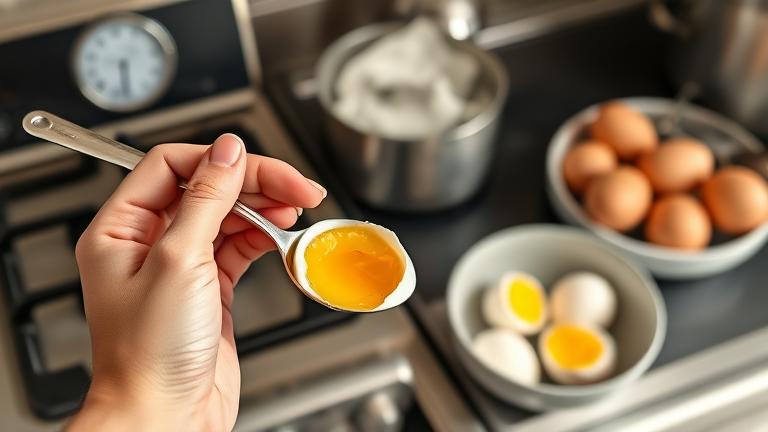
The Science of a Perfect Hard-Boiled Egg
When cooking eggs, the way heat is applied significantly influences the final texture and consistency. The proteins in an egg white, primarily albumin, begin to coagulate and set at around 144 degrees Fahrenheit (62 degrees Celsius). As the temperature increases, these proteins form a more rigid network, transforming the liquid white into a solid state.
Similarly, the yolk’s proteins start to coagulate at a slightly lower temperature, around 149 degrees Fahrenheit (65 degrees Celsius). The yolk’s fat content and different protein structures contribute to its creamier texture compared to the egg white. Precise temperature control allows for a range of consistencies, from a barely set, runny yolk to a fully firm one.
Achieving the perfect consistency, whether for a soft-boiled, fried, or scrambled egg, depends on managing the heat and cooking time. For instance, simmering eggs gently for boiling ensures the heat penetrates gradually, allowing for controlled coagulation of both the white and yolk. Conversely, higher heat for frying can cook the exterior more rapidly, requiring careful attention to prevent overcooking the delicate interior.
The Visual Cues
When boiling eggs, observing visual cues can help you gauge their doneness. The shell of the egg may change in appearance as it cooks.
Additionally, the overall look of the egg can provide clues about its stage of cooking.
The Spin Test
A simple test to determine if a hard-boiled egg is cooked to perfection involves a gentle spin. Place the egg on a flat surface and give it a quick rotation. A firmly cooked egg will spin smoothly and steadily, indicating that the inside has solidified.
An undercooked egg, however, will wobble and spin unevenly, revealing that the yolk is still liquid and the egg is not yet done. This test is a quick and easy way to check without needing any special equipment.
The Float Test
A simple water test can reveal both the freshness and the doneness of an egg. By placing an egg in a bowl of water, you can observe its buoyancy. A very fresh egg will lie at the bottom of the bowl on its side, indicating it is still good to eat.
An older, but still edible, egg might stand up on its bottom, while a spoiled egg will float to the surface. This happens because as an egg ages, the air cell inside it grows larger, making it more buoyant. This test is particularly useful for determining if eggs are still safe to consume before cooking.
Temperature Check
While boiling eggs might seem straightforward, achieving the perfect consistency relies on precise internal temperature control. Using a thermometer is key to accurately gauging an egg’s internal temperature for consistent results. This method ensures that each egg reaches the desired level of doneness, whether you prefer a soft, medium, or hard-boiled egg.
By monitoring the internal temperature, you can eliminate the guesswork and consistently produce perfectly cooked eggs. The principle behind this technique is similar to how other food items are cooked to specific internal temperatures for optimal texture and safety, ensuring a reliable outcome every time. While visual cues are helpful, a thermometer provides the most accurate measurement.
Troubleshooting Common Egg-Cooking Problems
When boiling eggs, a common problem is difficulty in peeling them. To ensure easier peeling, it’s recommended to use older eggs, as their whites tend to bond less to the shell. Placing the boiled eggs in an ice bath immediately after cooking also helps them peel more cleanly.
Another frequent issue is overcooking or undercooking, leading to either a rubbery texture or a runny yolk when a firm yolk is desired. Starting with eggs at room temperature rather than directly from the refrigerator can help them cook more evenly. A common technique to prevent cracking and ensure even cooking is to prick the wider end of each egg with a pin before boiling.
To achieve consistently perfect hard-boiled eggs, start by placing them in a single layer in a saucepan. Cover the eggs with cold water by about an inch, then bring the water to a rolling boil over high heat. Once boiling, immediately remove the pan from the heat, cover it, and let the eggs sit for 9 to 12 minutes, depending on desired doneness.