
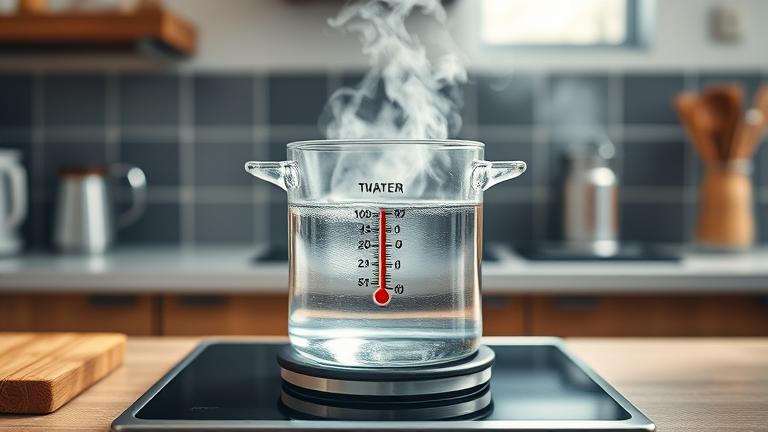
Introduction: Rethinking Boiling – Is It Always About Heat?
Traditional understanding of boiling has long centered around the idea that heat is the essential driver, pushing water to its boiling point, which at sea level is typically 100°C (212°F). This process is extensively used in cooking, sterilization, and scientific research, making it a fundamental concept in daily life. However, recent discoveries challenge this conventional notion, suggesting that boiling may not strictly require heat in the way we traditionally perceive it.
Water’s ability to undergo phase changes under various conditions hints at a more complex picture. Beyond the classic concept, phenomena such as cavitation, electromagnetic influences, and chemical reactions can induce boiling-like behaviors. These insights open new avenues for understanding and manipulating water in both industrial and scientific contexts. Consequently, it is essential to revisit and question the assumption that heat is the sole cause of boiling, considering alternative mechanisms and conditions that can produce similar effects.
The Science Behind Boiling Water: What Actually Happens?
Boiling involves the transition of water from a liquid to a vapor state. This process begins when water molecules gain sufficient energy to overcome intermolecular forces. As they do, vapor bubbles form within the liquid, rising to the surface and releasing vapor into the air. Under standard conditions, this happens at 100°C at sea level due to atmospheric pressure.
Understanding vaporization is key to grasping boiling. It occurs when molecules evaporate from the liquid surface, a process influenced heavily by temperature and pressure. When water reaches its boiling point, the rate of vaporization equals the rate of condensation, resulting in a steady state. This equilibrium explains why bubbles form and why boiling occurs at specific temperatures under set conditions.
Interestingly, boiling is also affected by external factors like pressure. Higher pressure environments elevate the boiling point, requiring more heat to vaporize water. Conversely, lowering pressure lowers the boiling point, which is utilized in vacuum distillation and other industrial processes. Such considerations are fundamental in both everyday cooking and complex scientific applications.
YouTube Video:
Challenging Conventional Wisdom: Can Water Boil Without Heat?
Emerging scientific research suggests that water can exhibit boiling-like phenomena without applying traditional heat. This phenomenon, often termed “cold boiling,” involves water demonstrating vigorous movement and bubble formation at temperatures well below 100°C.
Such behavior is observed in contexts such as sonoluminescence a process where intense sound waves generate transient bubbles that emit light and can reach high temperatures locally, essentially boiling water in tiny regions.
Ultrasound cavitation is another example where high-frequency sound waves create microbubbles that cause localized hot spots, effectively vaporizing water without external heat application. These hot spots are transient but can mimic the effects of boiling, demonstrating how physical agitation alone can induce phase changes.
Electromagnetic fields also influence water molecules, leading to bubble formation and phase transitions at lower temperatures. Certain electromagnetic frequencies can cause water molecules to align or vibrate, creating vapor bubbles temporarily. This indicates that external energies other than heat like sound or electromagnetic energy can trigger boiling behaviors.
Laboratory experiments have also illustrated that cavitation, electromagnetic influence, and chemical catalysts can induce boiling-like effects at room temperature or under non-thermal conditions. These phenomena expand our understanding of water’s dynamics and suggest innovative ways to heat, sterilize, or clean without traditional heating means.
Techniques to Simulate Boiling: Cold, Fast, and Beyond
Modern science harnesses advanced technologies to simulate boiling at room temperature or under non-thermal conditions. Ultrasonic devices are a prime example: high-frequency sound waves generate cavitation bubbles that cause localized high pressures and temperatures, effectively mimicking boiling effects. This technique is widely used in cleaning and material processing, where aggressive yet controlled agitation replaces the need for high heat.
Vacuum systems are another powerful method. By reducing pressure, they lower the boiling point of liquids, enabling vaporization at ambient temperatures. This method finds extensive use in laboratory experiments, distillation, and food preservation. For instance, vacuum distillation can extract components at much lower temperatures, preserving delicate flavors or chemicals.
Microwave-assisted and dielectric heating techniques leverage electromagnetic radiation to heat water molecules rapidly and uniformly. Microwaves agitate polar molecules, causing rapid heating, whereas dielectric heating applies specific electric fields to induce localized vaporization. These methods are particularly useful in culinary applications for fast cooking and in scientific research for precise thermal control.
In industrial settings, the combination of ultrasonic, vacuum, and electromagnetic techniques allows for the simulation of boiling under conditions that would be otherwise impossible or inefficient with traditional heat. Such innovations lead to cleaner, faster, and more energy-efficient processes, expanding the horizons of what can be achieved without direct thermal energy application.
Real-World Applications: Why Would You Boil Water Without Heat?
Room temperature boiling or similar effects have practical applications across various fields. In laboratories, they enable sterilization or chemical reactions that need precise thermal conditions without the risk of heat damage. Ultrasonic cavitation, for example, is used to clean equipment, break down biofilms, and facilitate chemical reactions efficiently.
Culinary uses include preparing foods quickly and safely. Chefs sometimes utilize techniques like rapid immersion in boiling water or high-pressure steam at lower temperatures to improve texture and flavor while conserving energy. Additionally, sous-vide cooking relies on precise temperature control achieved through water circulation and vacuum systems, sometimes mimicking boiling under controlled conditions.
In industry, vacuum-based and ultrasonic methods facilitate sterile environments and clean surfaces without high-temperature equipment. Autoclaves employ steam at ambient pressure to sterilize medical instruments efficiently, reducing wear and energy consumption. Such methods are also used in pharmaceuticals, where controlling temperature is crucial to maintaining drug integrity.
Furthermore, innovative processes like freeze-drying where sublimation occurs under controlled thermal conditions benefit from the ability to induce phase changes without heating to extreme temperatures. These versatile applications demonstrate how understanding and controlling boiling-like effects at low or no heat improve safety, efficiency, and quality in multiple sectors.
Myths, Misconceptions, and Scientific Explanations
Many misconceptions surround boiling. Some believe that boiling always requires direct heat through fire or stovetop burners. Scientific phenomena such as superheating and chemical interactions, however, reveal that liquids can boil at temperatures below the standard boiling point under specific conditions (Source: Test Food Kitchen).
For example, in microwave ovens, liquids can become superheated heated above their boiling point without actual boiling until disturbed, causing sudden violent boiling. Impurities or dissolved substances can also lower the boiling point, enabling boiling at lower temperatures, especially under pressure variations or chemical influences.
Furthermore, adding certain chemicals or impurities can trigger vaporization at reduced temperatures, disconnecting the process from simple heat application. These insights demonstrate that boiling is a phase transition driven by multiple factors, including pressure, energy input, and molecular interactions. Understanding these mechanisms is essential for safe cooking practices and scientific investigations alike.
This knowledge underscores the importance of not oversimplifying boiling as solely heat-dependent. Recognizing alternative pathways to phase change enhances both safety and innovation, opening doors to new technologies and improved methods across industries.